NORDICHI 2026 · TUTORIAL
The Three Bodies Framework
A Hands-On Method for Gesture Analysis in HCI
Sunday, 4 October 2026 at 9:30 am · Åbo Akademi University · Vaasa, Finland
THE PROBLEM
When you want to really get how people understand and relate to technology, the transcript is rarely the whole story.
Interviews are the backbone of qualitative HCI research. But language is a surprisingly imprecise medium for understanding what people are doing in human-computer interaction. Language often reaches its limits when people are at the edge of understanding, struggling to make sense of a new experience or articulate how they think something should work.
When language falls short, the body steps in.
Gestures provide continuity and fill the gaps when words fall short. When you learn how to systematically interpret gestures, you can see how they reveal mental models and give you clues about how people understand experiences and coordinate interaction in their environment in ways that words rarely capture.
Arguably, this is especially important in the era of LLMs and AI tools, which are increasingly being used to synthesize interview text. Technology that strictly transacts with language risks missing key insights and lines of inquiry that can only arise from attending to the body.
This tutorial gives you a way to draw insights from gestures and the body.
THE FRAMEWORK
What are the Three Bodies?
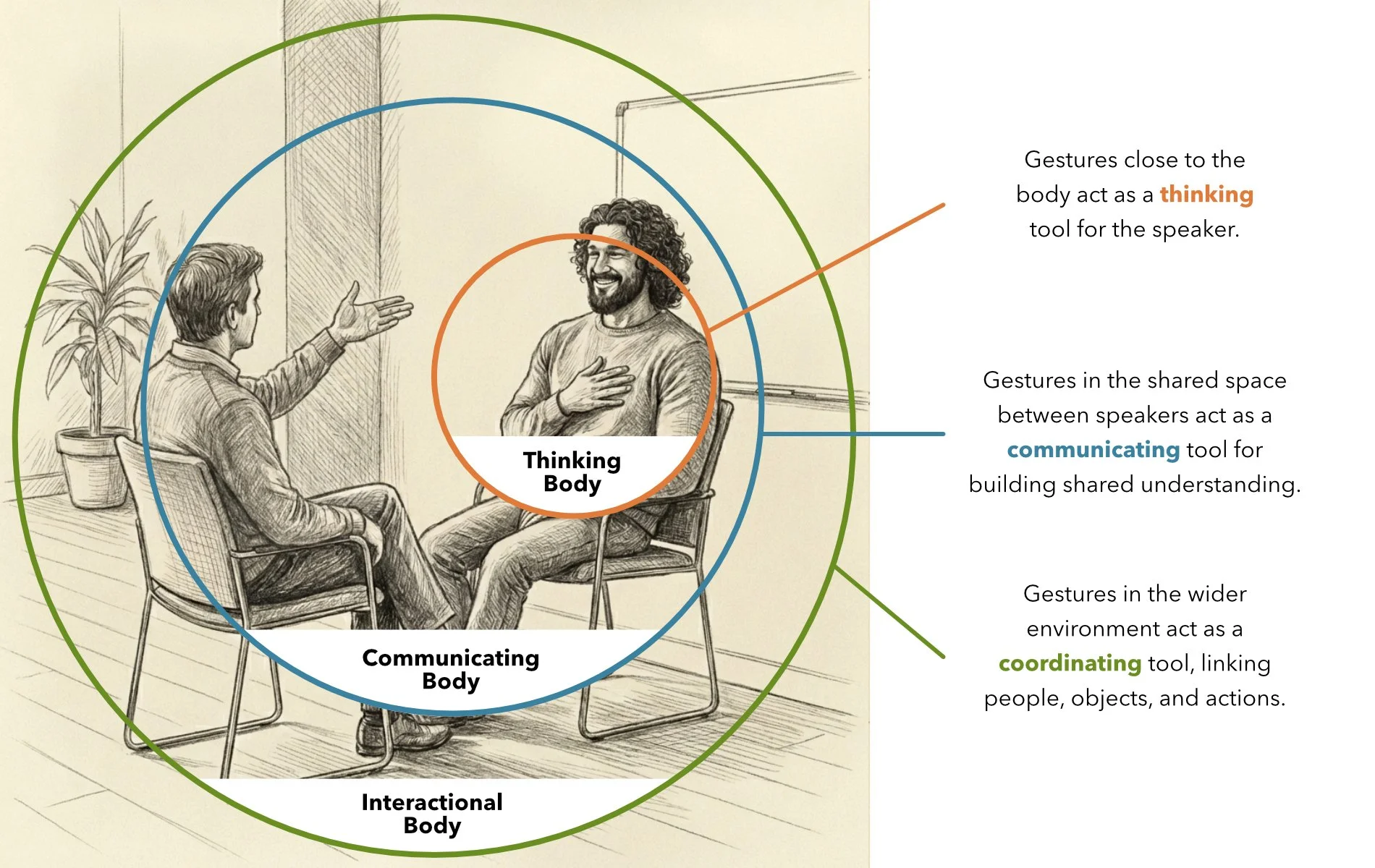
The Three Bodies framework is a way to make sense of the contribution of gestures in various daily interactions. Gestures are everywhere and they are everywhere in your data. But without a framework for interpreting them, their contributions are likely to be underutilized.
The Three Bodies Framework offers a unified methodology for identifying and interpreting gesture and embodied action in qualitative data.
It gives HCI practitioners a structured lens for identifying what gestures are doing at any moment in an interaction. This includes what kind of gesture it is as well as what work it is performing, for whom, and what that reveals about the person's experience, understanding, and relationship to the technology in front of them.
That interpretive precision is what turns embodied observation into design evidence.
-
The Thinking Body
Gesture that externalizes thought — revealing how participants understand, reason about, and relate to technology.

-
The Communicating Body
Gesture that extends and refines meaning in relation to speech — often saying what language alone cannot.

-
The Interactional Body
Gesture that coordinates attention, action, and engagement with people, objects, and the environment.

THE TUTORIAL
Four phases. Three hours. One shift in how you see interview data.
In two 90-minute sessions we will teach you the basics of how to go from raw video to insights that can fuel creative design ideation. This will be an interactive, hands-on learning experience. No prior knowledge is necessary, just bring curiosity and an open mind!
THE ANCHOR CASE
Grounded in a real design challenge.
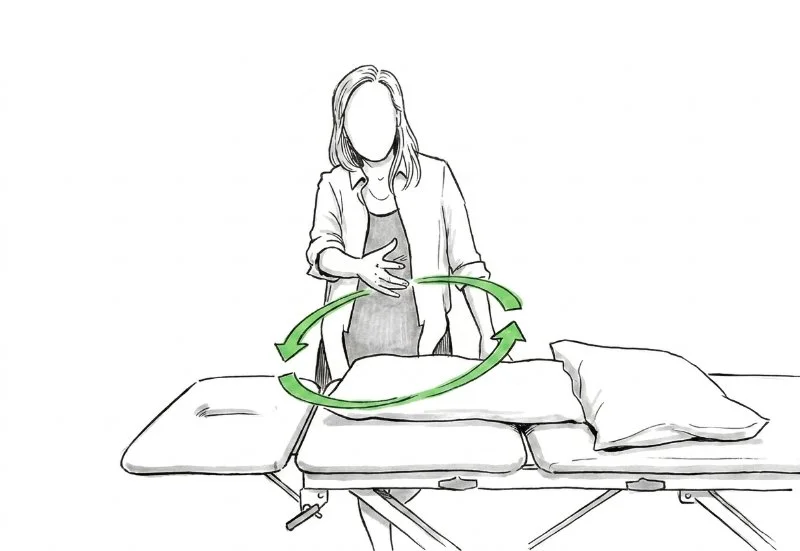
The tutorial is anchored in a real case study of a physician working with a patient in a messy, but fascinating clinical environment. You’ll see how doctors move fluidly across all registers of the Three Bodies as they do their work and explain their diagnostic process.
We will work together to understand both the embodied actions and gestures of the physician and translate those into concrete recommendations about the design of this and other clinical environments.
Meet your facilitators
-
Dane DeSutter, Ph.D.
PRODUCT RESEARCHER, MICROSOFT
Dane studies how spontaneous co-speech gestures reveal the nuances of people's mental models and what that means for designing human-centered products. He has applied gesture analysis across healthcare, enterprise software, and AI contexts. He is co-author of Body Talk (Rosenfeld Media).
-
Stephanie Scopelitis, Ph.D.
LEARNING SCIENTIST, BUTLER UNIVERSITY
Stephanie's research examines how the body functions as a resource for thinking, communicating, and interaction. She has designed and led interactive learning experiences for researchers, practitioners, and leaders across academia and industry. She is co-author of Body Talk (Rosenfeld Media).
JOIN US IN VAASA, FINLAND
Ready to turn what people “say” beyond words into design fuel?
Space is limited. Register early to secure your spot.